
Why Most Patients Leave the Office Not Understanding Their Perio Diagnosis

The exam is over. You told the patient what you found. They nodded, said "okay, I'll think about it," and went to the front desk.
Three days later their spouse asks what the dentist said. They answer: "I think I need a deep cleaning? Something about my gums."
That sentence is now the entire diagnosis, in the head of the person who decides whether to pay for it.
The number behind this
Research on medical communication has measured it. Patients forget between 40 and 80% of what a clinician tells them almost immediately, and nearly half of what they do remember is wrong. That finding comes from a review in the Journal of the Royal Society of Medicine, and it holds across specialties, education levels, and how well the clinician explains things.
This happens across all of medicine, not just dentistry. It lands hard in perio because perio is a diagnosis patients commonly decline, and the reason they give is often some version of "I didn't think it was that serious."
They weren't being difficult. They genuinely did not know.
You can see it happening in the room, if you know what to watch for. Our Patient Conversation Workbook lists the signs a patient has stopped absorbing anything:
- They stop asking questions, suddenly.
- They look glazed over or distracted.
- They say they need to "think about it" without asking a single clarifying question.
- They fix on a small detail and miss the main point.
- They ask you to repeat everything you just said.
That third one is worth sitting with. "I'll think about it" with no questions attached is not a patient weighing a decision. It is a patient who did not get enough to weigh.
They were told at the worst possible moment
Think about the position the patient is in when the findings get delivered.
They are lying nearly flat. Their bib may still be on. Someone's hands were in their mouth thirty seconds ago. They cannot easily speak, they cannot see your face without craning, and the social dynamic in the room does not invite questions. Most people in that chair are managing mild dread and waiting for it to be over.
That is when the important information arrives. It is the one moment in the visit when a person is least able to take anything in or ask a follow-up question.
What they heard was written for somebody else
During charting, the numbers go out loud. Three, two, four. Five, four, five, bleeding.
The patient hears every word of it. What they do not have is any idea that the numbers are about them, or that four is different from two, or that the numbers climbing on one side are the actual finding. Perio charting notation is a precise, efficient language — written for the chart, spoken to whoever is recording it.
So the patient sits through the most informative two minutes of their visit and takes nothing from it, because the content was never addressed to them. Then it gets summarized afterward in a sentence or two, delivered while they are still lying flat.
It was said once, out loud, and nothing went home with them
Spoken-only, one time, is the lowest-retention way to deliver anything. That is exactly what most perio findings get.
Compare it to how the rest of medicine handles a new diagnosis. A physician who tells a patient they have high blood pressure sends them out with a printed number, a target, and usually a prescription. The patient can look at it later. They can show it to someone.
After a perio exam, most patients leave with a follow-up appointment card and nothing else.
The decision gets made later, by somebody who wasn't in the room
Here is the part that decides whether treatment happens.
Very few patients accept significant treatment at the chair. They accept it at the front desk, in the car, or at the kitchen table that night, usually after talking to a spouse who controls half the budget and was not at the appointment.
Which means the person explaining your diagnosis at the moment the decision gets made is the patient, who understood it least of anyone in the room. They are your only advocate in that conversation, and they went into it with "something about my gums."
This is why case acceptance often has very little to do with how well you explained it. You explained it to the right person in the wrong conditions, and then handed the explanation off to them to repeat.
Four things that close the gap
None of these require more chair time.
Say it sitting up. Bring the chair upright, take the bib off, and deliver the diagnosis with the patient's eyes level with yours. It costs fifteen seconds and it changes who is in the conversation. Everything below works better once this is true.
Name it, in plain words, before you describe it. "We're seeing some areas of concern" is not a diagnosis, and patients do not treat it as one. Vague language is heard as optional. But the fix is not to reach for the clinical term either. The Workbook's rule is to lead with the most important information in everyday language: instead of "moderate periodontal disease requiring scaling and root planing," say "you have an infection in your gums, and it needs a deep cleaning to heal." Definite and plain at the same time. Then explain.
Show them something. Point at the actual sites. People do not argue with a picture the way they argue with a number, and a patient who can see where the problem is can find it again with their tongue that evening. Of the four, this is the one most likely to change the answer.
Send it with them. Whatever you showed them in the room, they should be able to pull up again at the kitchen table. That is the conversation you are actually trying to win.
Where Alta Voice fits
Two things have to be true for that to be realistic on a busy day.
First, the exam has to happen. In our survey of 102 dentists, hygienists, and office managers for The State of the Hygiene Appointment 2026, 60% said full-mouth perio charting is the first task cut when the schedule runs behind, and only 11% chart full-mouth perio at every hygiene appointment. You cannot show a patient findings you did not have time to record.
Alta Voice Perio charts the exam by voice. The hygienist calls out pocket depths, bleeding points, recession, and mobility, and the chart fills in while both hands stay in the patient's mouth. Practices report up to 60% less time spent charting and four to eight minutes back on every hygiene appointment.
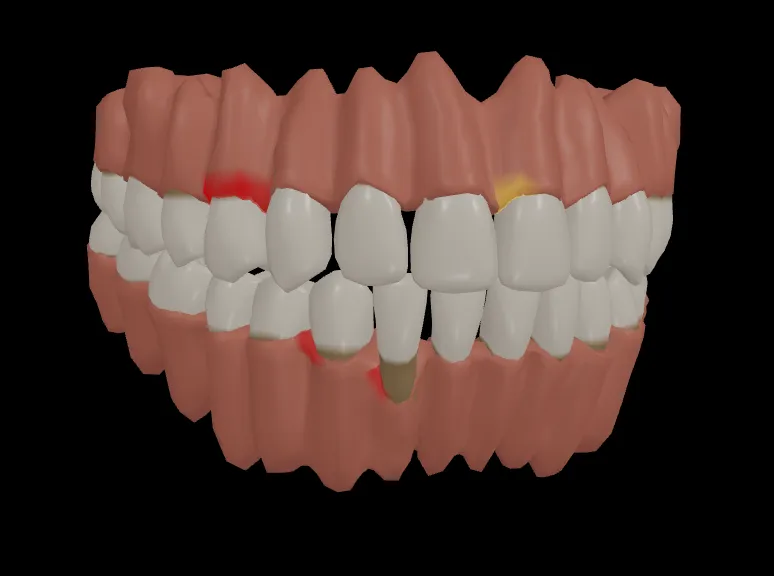
Second, the numbers have to become something a patient can look at. As the exam is charted, the 3D Perio Index builds a model of that patient's own mouth — inflamed sites in red, early sites in amber, recession shown where it is. The patient sits up and sees their own findings instead of hearing a list. That model and the report go home with them on their phone, which puts something real in front of the spouse who wasn't there. Practices using it report up to a 40% lift in SRP case acceptance.
The exam, the explanation, and the thing the patient takes home all come out of the same two minutes. In most practices those two minutes currently produce only the exam.

Try this at your next huddle
Ask the front desk to do one thing this week. When a patient checks out after a perio diagnosis, ask them casually: "So what did we find today?"
Write down what they say. Not whether they booked — what they say.
That answer is the version of the diagnosis that goes home and gets repeated to the person holding the checkbook. If it comes back as "something about my gums," you now know where treatment is being lost.
Give your team the tools to follow through
Make room for the exam, then make the findings easier to explain. These two free resources can help.
Want to see what a patient sees? Book a free demo of Alta Voice and watch a full perio exam charted by voice and turned into a report the patient can read.