
If your patient has gum disease, it's not your fault
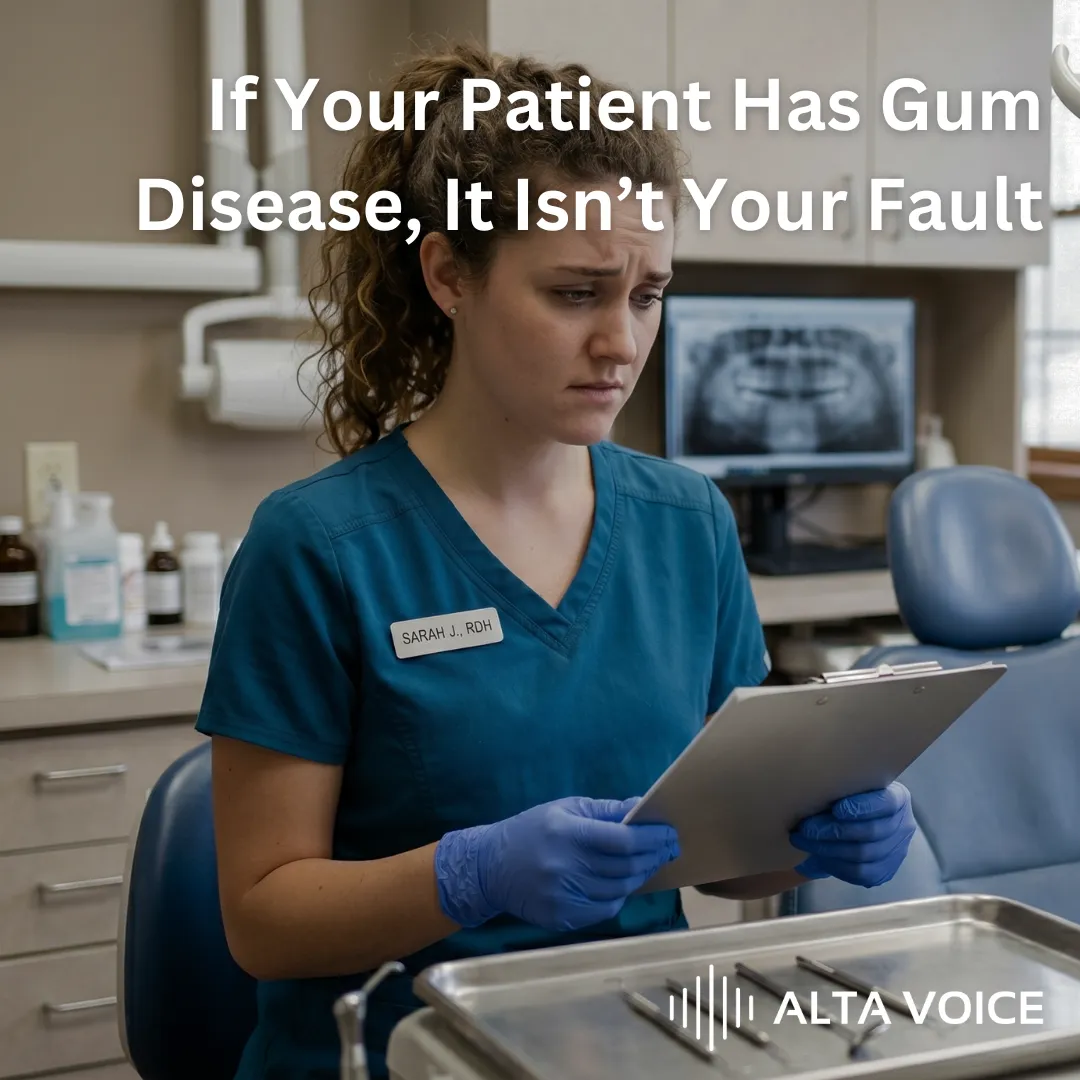
There's a feeling that doesn't get talked about enough in dental hygiene. A long-term patient sits down in your chair. You probe. The numbers tell a story you weren't expecting. Pocketing. Bleeding. Signs of periodontal disease — in someone you've been seeing for years. And somewhere in the back of your mind, a quiet voice says: Did I miss this? Is this on me? If you've ever felt that way, you're not alone. Not even close.
The weight hygienists carry
Wendy Briggs, RDH, founder of The Team Training Institute and one of the most respected voices in dental hygiene education, has spent more than 25 years coaching hygienists and dental teams across the country. She's heard this feeling expressed more times than she can count.
"I've had hygienists come to me and say, 'Wendy, I had a patient come in that's been a patient for 15 years and last time they came in, they had periodontal disease and I feel like I failed them,'" Wendy shared in a recent interview.
That guilt is real. And it makes sense. You care about your patients. You know their names, their families, their health history. You've spent years building trust with them. When something goes wrong with their oral health, it can feel personal.
But here's what Wendy says to every hygienist who comes to her with that feeling:
You have not failed them.
That's why they come every six months
Periodontal disease is not a reflection of poor hygiene care. It's a disease — one that develops over time, is influenced by genetics, systemic health, medications, and home habits that are entirely outside your control.
Wendy is direct about this: "Patients that develop periodontal disease, even though they've been consistent in coming every six months — that's why we have them come every six months. So that we can identify periodontal disease at the earliest possible stages, not wait for it to be progressed too far."
Think about that reframe for a second.
The recall system exists precisely because disease can develop between visits. Catching it early isn't evidence of failure. It's the whole point of the appointment. A patient developing perio under your care — and you catching it — is the system working exactly as it should.
When caring too much becomes a problem
Wendy describes something she sees constantly in her coaching work: a hygienist's love for her patients can actually get in the way of providing the best care for them.
It shows up in subtle ways:
- You know this patient can't really afford out-of-pocket treatment, so you don't bring it up.
- You don't want to upset them or make them feel guilty, so you soften the conversation.
- You've been seeing them for a decade and it feels awkward to suddenly tell them something is wrong.
- You present perio therapy like it's optional — a "deep cleaning" they can choose or decline.
Wendy sees this pattern constantly. "I think sometimes we take ownership of that. We might know too much about the patient. We prejudge their home life situation. We think they don't have the money."
The result? Patients go undiagnosed. Or they get diagnosed but don't accept treatment — because they didn't fully understand that they have a disease that needs to be treated.
The empathy that makes you a great hygienist can, when unchecked, work against your patients' health.
The data tells the difficult truth
The problem of under-diagnosing perio isn't unique to you or your practice. It's an industry-wide issue.
According to data Wendy cites in her training work, only about 3% of all dental billing codes are periodontal codes — despite the fact that a large and growing portion of the adult population has some form of periodontal disease.
She shared a striking example: a highly respected, progressive practice in downtown Washington D.C. — 15 treatment suites, excellent doctors — discovered that only 19% of their patients had a full periodontal chart recorded in the last two years.
"If we're not doing a full comprehensive chart for perio, you're not going to find it," Wendy said.
Practices aren't finding perio because they're bad at their jobs. They're not finding it because of time pressure, outdated systems, lack of tools, and sometimes — that quiet guilt that makes it easier to not look too hard.
Shifting the mindset
The first step toward better perio diagnosis isn't a new tool or a new script. It's a mindset shift.
Your job isn't to prevent your patients from ever developing disease. No hygienist can do that. Your job is to identify disease early, present it clearly, and give patients every opportunity to get healthy.
When you see a patient with periodontal disease, the right question isn't how did I let this happen? It's now that I've found it, what do I do?
Wendy is clear on this: "If your patients are diagnosed with periodontal disease, you have not failed them. You're trying to get them to a state of health."
That's the work. Finding it. Naming it clearly. Helping patients understand what they're dealing with.
You're not alone in this
If you've ever felt the weight of a patient's diagnosis sitting on your shoulders, take a breath. You didn't give them gum disease. You found it. And finding it is what you're there for.
The hygienists who catch perio early, communicate it clearly, and advocate for their patients' treatment — those are the ones making a real difference in long-term patient health.
And when you have the right tools, the right language, and a practice culture that supports comprehensive assessment, it gets easier to do that consistently.
Want to go deeper?
This topic is just one piece of a much larger conversation about what it means to run a high-performing, patient-centered hygiene department.
In the Hygiene Production Playbook — a free eBook from Alta Voice featuring an in-depth interview with Wendy Briggs — we cover the full picture: perio diagnosis rates, case presentation, treatment conversion, and the mindset shifts that separate good hygiene departments from great ones.
If you care about your patients and want to do more for them, this is worth your time.