
The Documentation Ceiling: Can Your Practice Grow Without Fixing Clinical Notes First?
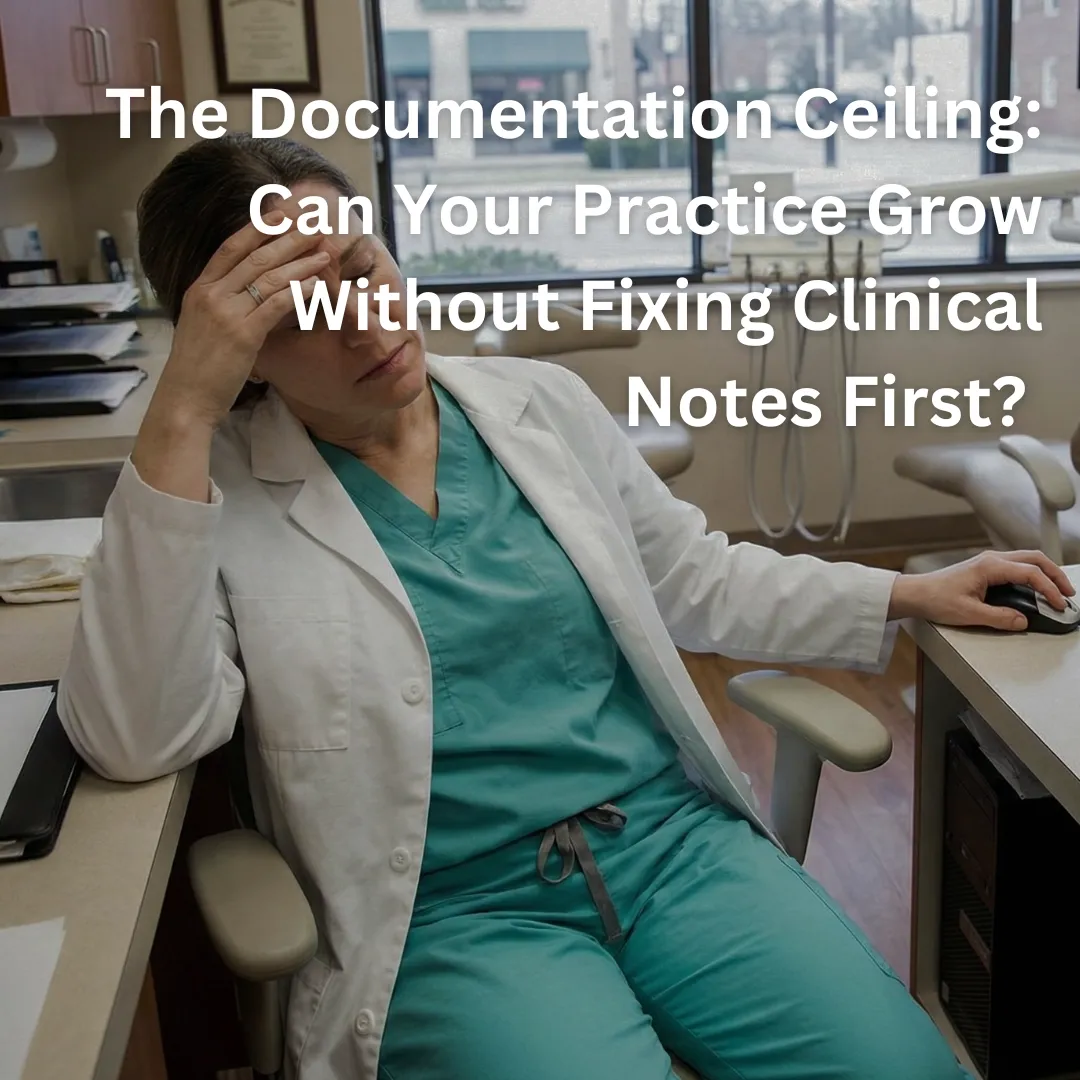
It’s 6:45 PM on a Thursday. Your last patient left an hour ago, your hygienist has gone home, and you’re still clicking through screens, trying to remember the details of Mrs. Patterson’s crown prep from this morning. Your family’s waiting for dinner. This wasn’t supposed to be the hard part of dentistry.
Here’s the paradox every dental practice faces: clinical notes are absolutely essential for patient care, legal protection, and insurance requirements. They’re also slowly draining the joy from your workday and, if left unaddressed, will eventually undermine everything you’ve built. But here’s what most practitioners don’t realize—the problem isn’t the notes themselves. It’s how we’re doing them, and the long-term cost of ignoring this problem.
And the real cost? It’s not just the hours. It’s what those hours are stealing from you over time.
The Five Hidden Ways Notes Are Sabotaging Your Day
The Context-Switching Tax
Every time you move from examining a patient to updating their chart, your brain has to shift gears completely. Research shows that every interruptions costs you minutes of productivity. Now multiply that by 20 patients a day. You’re not just losing time, you’re fragmenting your attention so severely that you’re mentally exhausted by lunch. The constant toggle between clinical thinking and clerical work isn’t multitasking; it’s cognitive whiplash.
The “I’ll Do It Later” Backlog
We’ve all done it. The schedule’s packed, so you tell yourself you’ll finish the notes after your last patient. By 5 PM, you’re facing a pile of half-remembered procedures, trying to reconstruct conversations and clinical decisions from hours ago. Not only does this steal your evening, but your notes become less accurate. What specific shade did you choose for that composite? What exactly did the patient say about their jaw pain? The delay costs you both time and quality.
Template Fatigue and Copy-Paste Mediocrity
Templates were supposed to save time. Instead, they’ve created a new problem: notes that sound like everyone else’s notes, packed with generic language that doesn’t capture what actually matters. You spend time deleting irrelevant template text and customizing notes, which somehow takes longer than writing from scratch would have. Worse, these cookie-cutter notes are clinically useless when you’re trying to remember what happened at the next appointment.
The Long-Term Price You’re Paying
Here’s what most dentists don’t realize until it’s too late: documentation problems don’t stay documentation problems. They metastasize into practice-wide issues that undermine everything else you’re trying to build.
The Burnout Trajectory
Staying late to finish notes isn’t just inconvenient—it’s a warning sign. Research shows that administrative burden is one of the top contributors to clinician burnout in healthcare. When you’re mentally exhausted from context-switching all day and then face hours of catch-up documentation at night, you’re not building a sustainable career. You’re on a countdown timer. The dentists who leave the profession early rarely cite the clinical work as the problem. It’s the everything else that breaks them.
The Growth Ceiling
Here’s the cruel irony: your documentation process might be manageable now, but it becomes your practice’s growth ceiling. When you’re seeing 15 patients a day, 10 hours a week on notes feels survivable. Scale to 20 or 25 patients? Suddenly you’re drowning. Many successful dentists hit a wall not because they can’t attract patients or don’t have the clinical skills, they simply can’t scale their administrative workflow. Your broken documentation process becomes the limiting factor on your practice’s potential.
The Hidden Financial Drain
Let’s do the math. Ten hours per week on documentation equals 520 hours per year. If your productive hour as a clinician is worth $300 (a conservative estimate), that’s $156,000 in annual opportunity cost. That’s not revenue you’re losing, it’s revenue you never had the chance to generate because you were typing instead of treating. Over a 30-year career, poor documentation processes could cost you millions in unrealized income, not counting the compounding effects of investment and growth.
The Culture Killer
When you’re stressed, your team feels it. When you’re consistently staying late, morale drops. When your hygienists and assistants are also buried in documentation, they start looking for jobs elsewhere. Staff turnover costs the average dental practice $40,000-$60,000 per employee when you factor in recruiting, training, and lost productivity. And it all starts with systems that make people’s jobs harder instead of easier. A practice culture built on frustration and inefficiency doesn’t attract talent, it repels it.
The Path Forward
You’re not bad at documentation. The system is bad at supporting you. And the stakes are higher than you think. The goal isn’t just perfect notes. It’s building a sustainable practice that can grow without breaking you or your team.
Start by evaluating your current workflow honestly. Are you documenting in real-time or playing catch-up? Are your templates helping or just adding clicks? How many hours per week are you really losing to this problem, and what is that costing you over five years? Ten years?
Ready for a Solution for Documentation?
Consider Alta Voice. Alta Voice has the premier voice-to-text AI tools that create amazing clinical notes in a fraction of the time when compared to manual typing and even templates.
AI Clinical Notes from Alta Voice are saving practices hours, headaches, burnout, and more. So, the question isn’t whether you can afford to address this problem. It’s whether you can afford not to.
Get a demo of Alta Voice today and see what AI Clinical Notes can do for your practice. Schedule here.
AI helped us write this article and it can help your practice too. Schedule a demo with Alta Voice today.