
Is There a Downside to Spending Too Much Time Taking Clinical Notes in Dentistry?
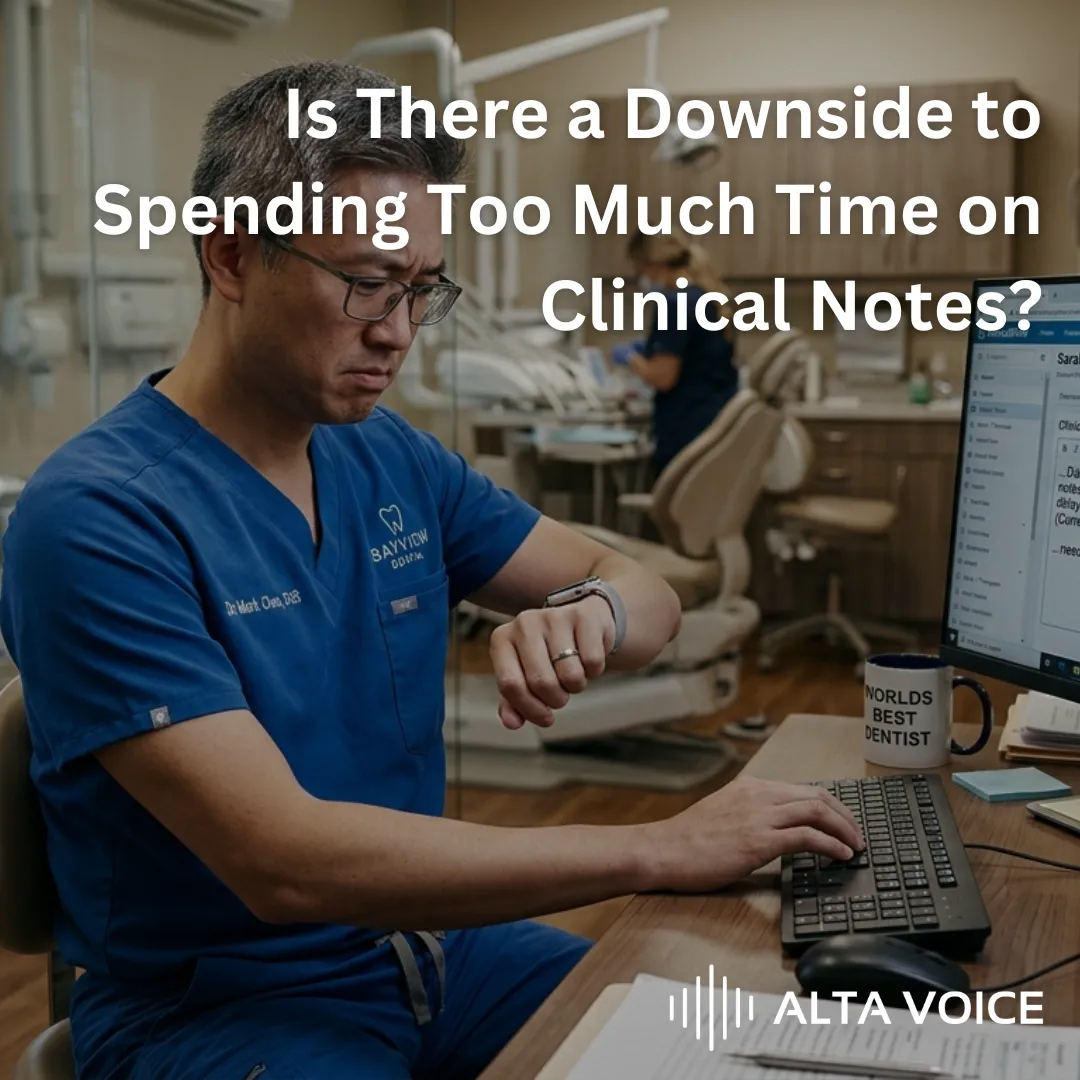
Dentists and dental hygienists who spend excessive time on clinical charting risk burnout, reduced patient connection, and compromised work-life balance. Learn how AI clinical notes can help.
You became a dentist or dental hygienist to work with patients — to deliver care, build trust, and make real differences in people’s oral health and overall well-being. You did not go through years of rigorous training to spend your afternoons hunched over a keyboard, typing clinical notes after the last patient has gone home.
And yet, for a growing number of dental professionals, that is exactly what is happening. Clinical documentation — charting perio findings, documenting procedure notes, recording treatment plans, logging patient communications — is consuming an outsized portion of the dental workday. And the problem is not a technical one. The downside of spending too much time on clinical notes is deeply human: it erodes the experience of practicing dentistry, strains relationships with patients, and quietly chips away at the life you have outside the clinic.
Let’s look at what the evidence actually shows — and what it means specifically for dentists and dental hygienists.
How Much Time Are Dental Professionals Actually Spending on Documentation?
Clinical documentation is a non-negotiable part of dental practice. The American Dental Association advises that dentists strive to complete treatment notes within 24 hours of a patient encounter, and accurate charting is essential not only for continuity of care, but for legal protection, insurance compliance, and practice management. The standard is high — and rightly so.
But the time required to meet that standard adds up fast. In high-volume dental practices, dentists and hygienists spend between 45 and 60 minutes each day on documentation tasks alone — and that time often spills beyond scheduled patient care hours. Research across the broader healthcare field puts the average clinician’s documentation burden at more than 13 hours per week, a figure that has grown 25% over seven years. Dentists’ own surveys reveal that they are spending close to one-third of their total patient interaction time on record keeping — nearly double what they believe the ideal ratio should be.
For dental hygienists, the pressure is compounded by tight appointment windows. A hygiene schedule typically runs back-to-back, with little buffer for charting between patients. Perio notes, oral cancer screening documentation, radiograph findings, patient education records, and referral notes all need to be captured accurately — and the clock is always ticking.
The Real Cost: What Over-Documentation Actually Does to Dental Professionals
1. It Pulls You Away from Your Patients
One of the clearest findings in healthcare documentation research is the effect on the patient relationship. When clinicians are focused on screens instead of people, the quality of interaction suffers. Patients notice when their provider seems more engaged with a chart than with them. Nearly 70% of physicians across specialties report that EHR demands take valuable time away from patients — and dentistry is not immune to this dynamic.
In a dental setting, this plays out in specific ways. A hygienist furiously typing perio findings while simultaneously explaining brushing technique is not fully present for either task. A dentist completing yesterday’s procedure notes between today’s appointments is starting those appointments already behind. The documentation that is supposed to support quality care can, when it becomes burdensome, actively undermine it.
2. It Contributes Directly to Burnout
Burnout in the dental profession is not a hypothetical risk — it is an active crisis. The American Dental Association’s 2021 Dentist Health and Well-Being Survey found that anxiety among dentists had more than tripled since 2003. Among dental hygienists, approximately 31% report experiencing burnout, with symptoms including emotional exhaustion, depersonalization, and a diminished sense of personal accomplishment.
Administrative burden, including documentation, is consistently cited as a primary driver of that burnout. The stressors that cause burnout among dental hygienists include time constraints and the intense pressure to provide thorough care in compressed appointment windows — and clinical charting sits squarely within both categories. When documentation bleeds into lunch breaks, end-of-day closing routines, and evenings at home, it stops being just a workflow problem and becomes a wellness problem.
The consequences are real. Burnout in dental professionals is associated with physical symptoms including fatigue and musculoskeletal complaints, psychological effects including anxiety and depression, decreased job satisfaction, and — critically — reduced quality of patient care. These are not soft outcomes. They affect patients, practices, and the dental professionals themselves.
3. It Steals Time You Cannot Get Back
Beyond the clinical environment, there is a simpler human cost that often goes unspoken: documentation that is not completed during clinic hours has to be completed somewhere else. For dental professionals, that somewhere else is usually home.
End-of-day charting that delays practice closing. Notes carried into evenings. A Saturday morning spent finishing records from a busy Friday. These are not edge cases — they are common realities in dental practices across the country. And every hour spent on documentation at home is an hour not spent with family, not spent on recovery, and not spent on the activities that make a sustainable career possible.
The dental hygiene profession is already facing a retention crisis. The average hygienist leaves the field after just seven years. Burnout — fueled in part by administrative overload — is a significant driver of that departure. When the profession loses experienced hygienists, patients lose access to high-quality preventive care and practices lose irreplaceable clinical expertise.
The Good News: Excellent Documentation and Personal Well-Being Are Not Mutually Exclusive
The solution to over-documentation is not to document less carefully. It is to document more efficiently. The goal is complete, accurate, defensible clinical notes — produced in a fraction of the time currently required.
AI-powered ambient documentation technology has demonstrated compelling results in broader healthcare settings. Research published in JAMA Network Open found that AI scribing tools produced a 21% absolute reduction in burnout among physicians at Mass General Brigham and a 31% improvement in documentation-related well-being at Emory Healthcare. These tools record clinical encounters, draft notes for clinician review, and integrate with existing record systems — freeing providers to focus on patients rather than keyboards.
In dental-specific contexts, voice-to-text and AI note generation tools are showing similar promise. High-volume practices report saving 30 to 45 minutes of documentation time per provider daily — time that flows back into patient care, professional development, or simply getting home on time. One large clinical rollout of ambient AI documentation reported a 51% reduction in time spent per consultation on documentation.
For dental professionals, the implications are straightforward. Better documentation tools do not just save time. They reduce the cognitive load of charting, decrease the likelihood of errors and omissions, support compliance, and make it possible to be fully present with patients during appointments — because the note-taking burden is no longer competing for your attention.
Stop Charting After Hours. Start Using Alta Voice.
Alta Voice AI Clinical Notes is built for dental professionals who want exceptional documentation without sacrificing their time, their patients, or their sanity. Instead of typing notes after every appointment — or staying late to finish your charts — Alta Voice generates complete, accurate, dentistry-specific clinical notes in a fraction of the time of manual typing and traditional templates.
With Alta Voice, you get:
- Thorough, compliant clinical notes generated in seconds — not minutes
- Dental-specific language for perio notes, procedure documentation, treatment plans, and more
- More time with patients. Less time at the keyboard.
- A workday that actually ends when it should
AI helped us write this blog post. AI can help your practice too. Schedule a demo with us to see how.