
Is Being Behind on Clinical Notes Really Such a Big Deal?
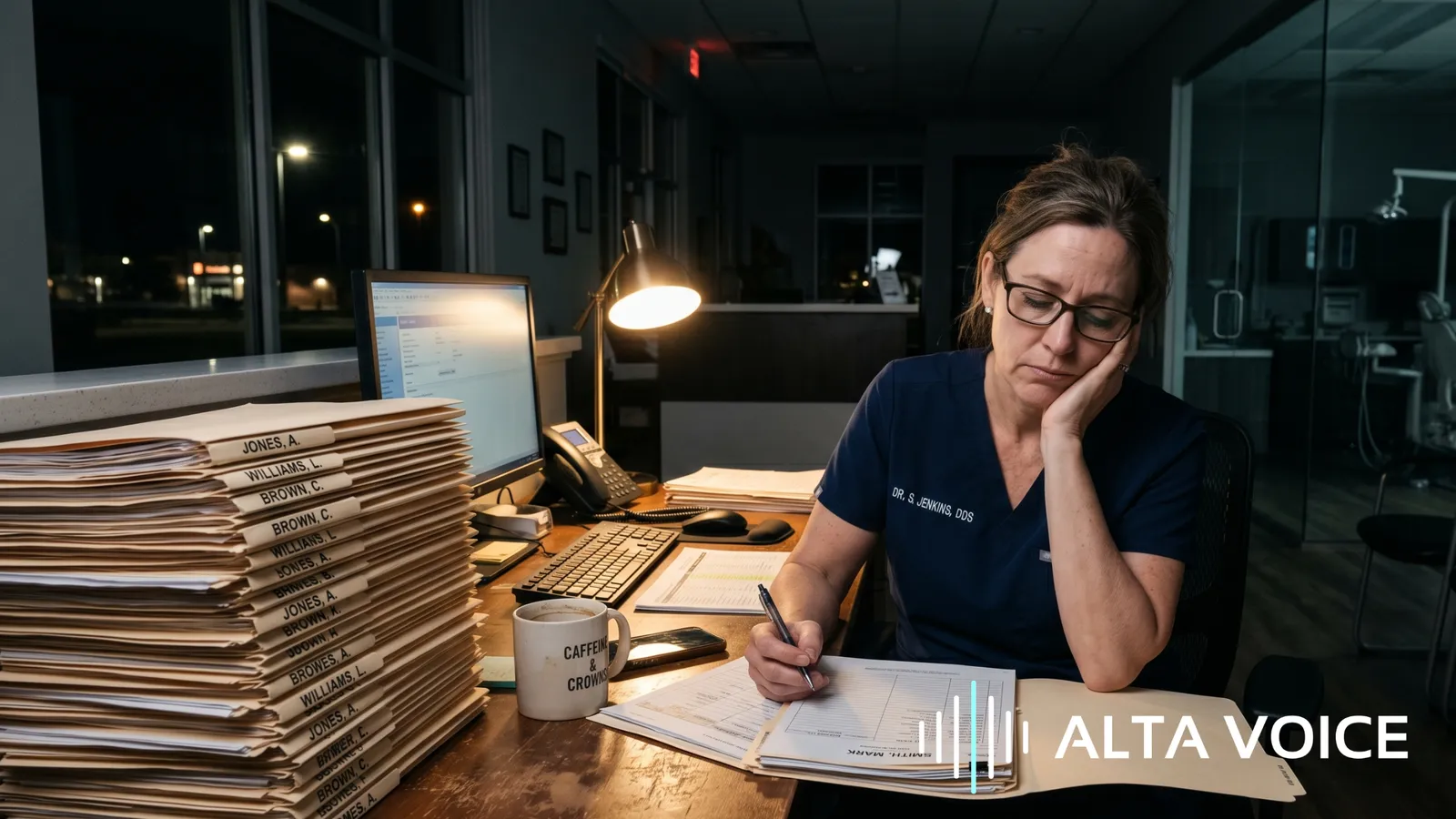
If you work in a dental practice, you already know the rhythm. The appointment ends, the patient heads to the front desk, and there’s already someone in the next operatory. The notes? You’ll get to them. Maybe between patients. Maybe at lunch. Maybe at the end of the day — if you’re lucky.
It’s one of the most universal experiences in dentistry: clinical notes perpetually waiting at the back of the queue. And because it happens everywhere, in every kind of practice, it can start to feel normal. Harmless, even. But is it?
Why Falling Behind on Notes Is So Easy — and So Common
Let’s be honest about what’s working against dental professionals here. The day is structured around patients, not paperwork. Appointments are scheduled back-to-back, with little margin built in for documentation. The moment one patient leaves the chair, the clock is already ticking for the next one.
Add to that the genuine cognitive load of patient care — staying present, communicating clearly, making clinical decisions in real time — and it becomes obvious why notes tend to slip. Writing a thorough clinical record requires a mental gear shift that’s genuinely hard to make mid-flow.
Many practices have tried to engineer around this problem. They’ve implemented templates. They’ve delegated drafting to assistants. Some of these help at the margins — but as you’ll see from the data, none of them reliably solve the timing problem.
The result is that deferred documentation has become the default for a significant share of the profession. In a January 2026 survey of dental professionals conducted by Alta Voice, only 17% of respondents reported completing notes during the appointment itself. Another 47% complete notes immediately after — which is still reasonably prompt. But more than one in five practitioners are routinely finishing notes at the end of the day or later.
That might not sound alarming. But the data tells a very different story about what those delays are actually costing.
The Real Consequences of Falling Behind on Clinical Notes
Getting behind on notes feels like a paperwork problem. In reality, it’s a risk management problem, a revenue problem, and a burnout problem — all at once.
Audit Risk Climbs with Every Hour of Delay
When notes are completed during the appointment, audit concern rates are effectively zero. The moment documentation gets pushed to the end of the day, that number jumps to 30%. Push it to days later, and half of practitioners in that category express concern about whether their notes would hold up under scrutiny.
This isn’t just anxiety. It reflects a real documentation problem. Notes written hours or days after a procedure rely on memory rather than contemporaneous observation. Details get fuzzy. The specificity that insurers and auditors look for — the kind of documentation that proves medical necessity, justifies a billing code, or demonstrates appropriate standard of care — erodes with time.
Insurance audits have consequences that go well beyond a single denied claim. Clawbacks, increased scrutiny on future claims, and reputational damage to the practice are all on the table. The window for protection is narrow — and it starts closing the moment the patient leaves the chair.
Claim Denials Increase — and Confidence Collapses
Among practitioners who complete notes during the appointment, only 8% report having claims denied or questioned due to documentation. That number rises to 20% for end-of-day completers and 25% for those finishing notes days later.
Perhaps more telling: of the practitioners who have actually experienced a claim denial, confidence in their note quality collapses almost entirely. Only 11% still feel good about their documentation quality after going through a denial — and zero percent feel confident their notes would protect them in a future audit.
A claim denial is expensive and time-consuming to resolve. But it’s also a signal that the underlying documentation system has a structural weakness. Waiting for a denial to happen before addressing that weakness is a costly way to learn the lesson.
Provider Stress Compounds — and Doesn’t Go Away
The survey found a direct and dramatic relationship between documentation timing and provider stress. Among practitioners completing notes during or immediately after appointments, stress rates sit at 17% and 15%, respectively. For end-of-day completers, that number jumps to 40%. For those finishing notes days later, it reaches 100% — every single respondent in that group reported being stressed about clinical notes.
That’s not a coincidence. When documentation piles up, it creates a mental background load that doesn’t switch off between patients. The notes from yesterday are still undone while you’re trying to be fully present with today’s patients. The notes from today will follow you home. The cumulative effect is exactly the kind of chronic, low-grade stress that leads to burnout.
The survey data bears this out: 14.3% of all respondents cited burnout as a direct concern related to clinical notes — and that number was significantly higher among the practitioners who struggled most with documentation timing.
Delegation Doesn’t Fix It — It Often Makes It Worse
Many practices have turned to team-assisted documentation as a solution — having a staff member draft the note and the provider review and approve it. On paper, this sounds like a reasonable division of labor. In practice, the survey data reveals a troubling pattern.
Practitioners using team-assisted notes fall behind on documentation 83% of the time, compared to 48% for those who handle notes solo. Their stress rate is 50% — more than double the 19% reported among solo practitioners.
The reason makes sense when you think about it: delegation creates a coordination bottleneck. The provider still has to review every note before it’s finalized, which means the approval queue becomes its own form of backlog. Instead of eliminating the documentation burden, delegation often just reshapes it — and adds a layer of complexity in the process.
Experience Alone Won’t Save You
One of the most striking findings in the survey: 68% of respondents had been practicing dentistry for more than 20 years. These are not rookies still building their workflows. And yet, 27% of veteran practitioners still reported being moderately or very stressed about clinical notes.
That’s a significant data point. It means the documentation burden doesn’t resolve itself with time, experience, or practice optimization. It’s a structural challenge — one that individual effort, however consistent, can’t fully overcome.
📊 Want to see the full picture?
The data in this article comes from the 2026 State of Clinical Notes in Dentistry — a survey of dental professionals about how they document care, where they struggle, and where the industry is headed. If you’d like to get the complete State of Clinical Notes report, click here.
So What’s the Answer?
The data makes one thing unmistakably clear: the practices that protect themselves best are the ones that complete documentation closest to the point of care. Not at the end of the day. Not the next morning. During or immediately after the appointment.
The challenge, of course, is building a system that actually makes that possible — without slowing down the clinical team or adding cognitive burden to an already demanding workday. Templates help some. Voice dictation helps some. But the survey also makes clear that these tools, used in isolation, aren’t enough for a large portion of the profession. The problem is structural, and it requires a structural solution.
That’s where AI-assisted documentation is starting to change the equation. Among the highest-burden practitioners in the survey — those struggling most with timing, stress, and burnout — 74% said they were open to adopting AI for clinical notes. That appetite is directional: it reflects a profession that has tried the conventional solutions and is ready for something genuinely different.
⚡ How Alta Voice Can Help
Alta Voice is an AI-powered voice documentation platform built specifically for dental practices. Instead of typing, templating, or catching up at the end of a long day, you simply speak — and Alta Voice generates structured, thorough clinical notes in real time, right at the point of care.
Here’s what that means in practice:
Notes captured up to 85% faster than manual typing
Structured, consistent records designed to meet documentation standards — which means better audit protection and fewer denied claims
Notes completed before the patient leaves the chair — eliminating the end-of-day backlog entirely
Compatible with all major practice management software, including Dentrix, Eaglesoft, Open Dental, and Curve Dental
The problem isn’t how hard your team is working — it’s that the old methods of documentation weren’t built for the pace of a modern dental practice. Alta Voice was. See how it works when you get a demo here.
Getting behind on clinical notes might feel like a small, manageable inconvenience. The data says otherwise. Every hour of delay increases audit risk, claim denial rates, and provider stress in measurable, compounding ways. And unlike many challenges in running a practice, this one has a clear structural solution — you just have to be willing to reach for it.
AI helped us write this post and it can help you dental practice too. Find out how AI from Alta Voice can help your practice when you get a demo.